 |
Topographiesof Ruin |
|
| Home | Galleries | Reflections | Prints | Books | Events | Contact us | ||
 |
||
| View Gallery 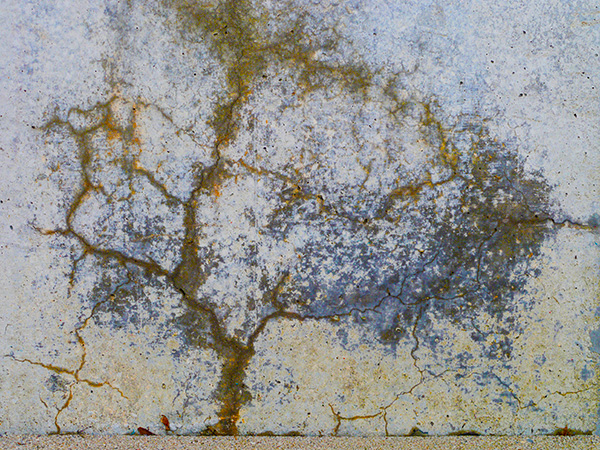 |
| "Things fall
apart; the centre cannot hold." —W.B. Yeats, "The Second Coming" "Look on my Works, ye Mighty, and despair!" —Percy Bysshe Shelley, "Ozymandias" |
What you are looking atThis image shows efflorescence on the surface of the concrete column, caused by water seeping down through micropores in the concrete, dissolving various materials, and eventually reaching the surface, where it evaporates and leaves the dissolved substances behind. The chemistry of destructionConcrete is strong and durable, but it is porous and contains a network of capillary pores, microcracks, and voids. These pores are filled with a highly alkaline solution (pH about 12.5 to 13.5), rich in calcium, sodium, and potassium hydroxides. This alkalinity forms a tightly bonded oxide film on the embedded rebar steel that protects it from corrosion. When water moves through it, it triggers a chain of chemical and physical processes that dissolve the cement paste, corrode the steel reinforcement, and eventually crack and break up the column. Water carries and reacts with dissolved gases and salts, mainly carbon dioxide, oxygen, chlorides (from de-icing salts or marine exposure), and sulphates. As water percolates through concrete, it dissolves calcium hydroxide and carries calcium ions, weakening the protection around the steel. The concrete becomes more porous, letting in more water and accelerating further leaching. Chlorides carried in by water (de-icing salts, sea spray, contaminated aggregate) can break down the protective film, causing pitting corrosion, which can be severe and concentrated in small areas. Sulphates react with cement compounds to form expansive products that crack the concrete from within. Once the protective layer on the rebar is compromised and both water and oxygen are available, the rebar corrodes through an electrochemical process. The rust that is created takes up considerably more volume than the steel it came from and generates enormous internal pressure. Concrete, weak in tension, cracks along the rebar, then delaminates and finally spalls off in chunks, exposing the steel and speeding up corrosion, further reducing the column's load capacity. EfflorescenceBefore this destruction is apparent, water moves downward under gravity, emerges at the lowest exposed points, and evaporates, leaving salts on the surface. When calcium-rich water reaches the surface and evaporates, it leaves behind salts. This efflorescence can look like white powder, streaks, or a crusty film, often heaviest around cracks and joints at the base. Iron-bearing water oxidizes on contact with air, depositing orange, red, or brown iron oxide that stains the surface or leaves brown halos around cracks. What do you see? - PareidoliaIs it a tree? The mind tends to find meaningful shapes in vague or random stimuli. This phenomenon is called pareidolia, from the Greek para (beside, alongside) and eidolon (image or form). Human vision evolved for rapid recognition, not careful measurement, so it quickly flags potential threats from what little visual information is available. A false alarm can cause embarrassment; a missed threat could cost everything. Responses to patterns that may be faces get special treatment. Infants prefer face-like patterns within hours of birth, and a dedicated region of the brain, the fusiform face area, responds strongly to them. Two dots above a line are often enough to trigger the effect. This is why a pair of knots in a plank and a crack beneath them can suddenly stare back at you, and why once you have seen the face, you cannot easily unsee it. A long history of lookingArtists have deliberately cultivated this way of seeing for centuries. Leonardo da Vinci advised painters to study old, stained walls and mixed-up stones, promising they would find landscapes, battles, strange faces, and endless other things. He treated the wall as a prompt for the imagination rather than a flaw. Chinese scholars collected "scholar's rocks," valued for their resemblance to mountains, clouds, and beasts, and displayed them as miniature worlds for contemplation. In Europe and elsewhere, "picture stones" such as Florentine pietra paesina, a limestone whose mineral patterns resemble ruined cities and landscapes, were cut and framed as though painted by nature herself. The Surrealists later turned this tendency into a method, using techniques like frottage (rubbing a pencil over a textured surface) and decalcomania, using chance textures as seeds for imagery. In contemporary psychology, the Rorschach inkblot test uses the ambiguity of visual forms to draw out how a person's mind organizes what it sees. Not a mistake, an invitation to visual adventuresPareidolia is often described as a mistake, but it is better understood as evidence of a mind that is always eager to make sense of things. We are pattern-finding creatures, and the world is generous with raw material. The effect is also inherently collaborative: the ‘stone' supplies the visual stimulation, and the viewer supplies the meaning. Two people can look at the same surface and find different creatures, and neither is wrong. There is a quiet pleasure in it, too. Noticing a face on a column is slowing down and looking at something ordinary long enough for it to become strange. In that sense, seeing faces, animals, plants, or even ancient armour, in ‘stone' is a small daily practice of wonder, available to anyone with an available mind. |
| View the Gallery |
| © 2026 CWP - ARCHIdictus |